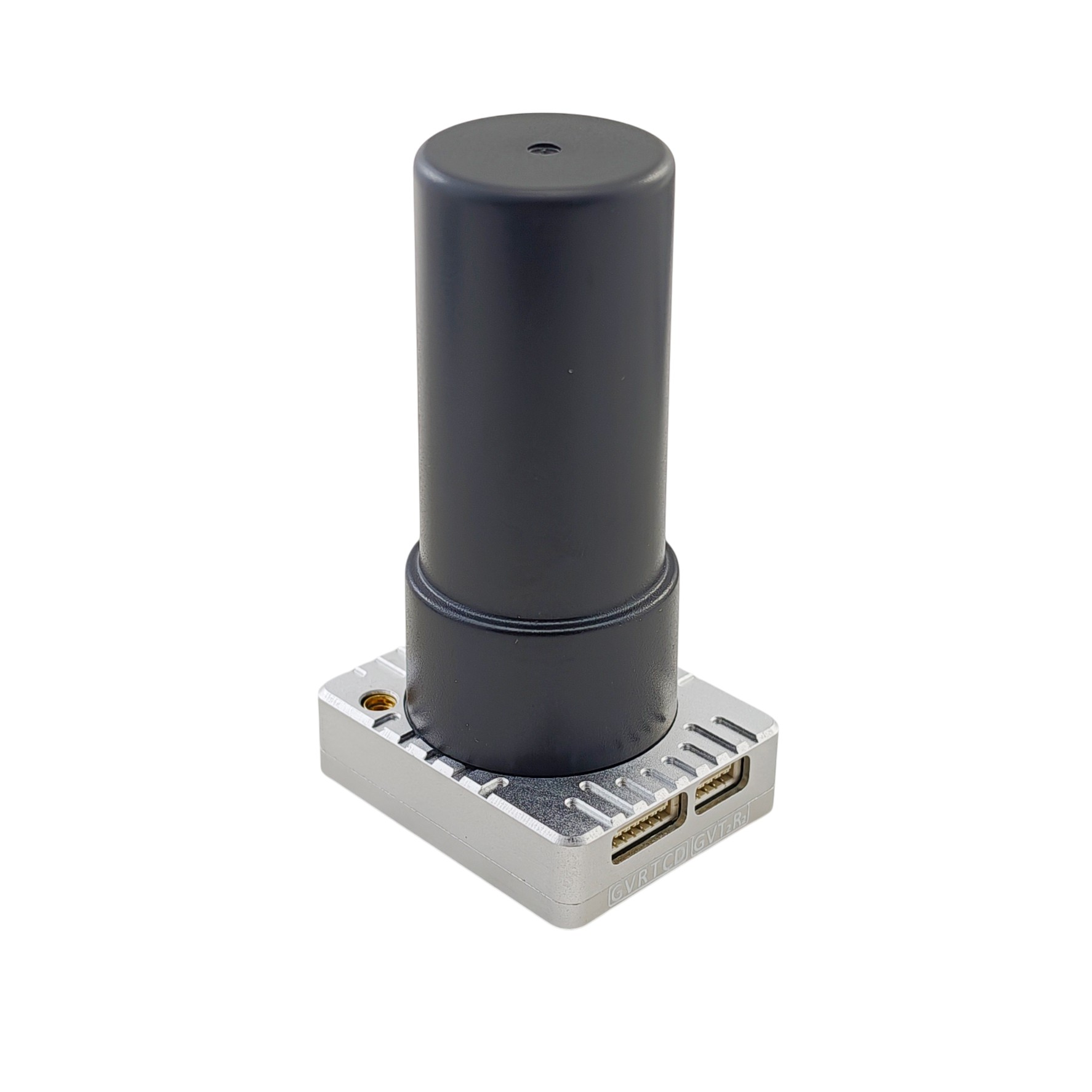
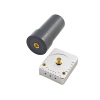
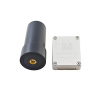
MicoAir MA-RTK-AIR-982 is the most powerful RTK GNSS module in the MicoAir RTK series, built on the triple-band UM982 receiver with support for L1, L2 and L5. It works as a rover, meaning it receives RTK corrections from a ground base station or the NTRIP network, and achieves horizontal accuracy of 0.8cm + 1ppm and vertical accuracy of 1.5cm + 1ppm. Without corrections, it works as a standard GNSS module with accuracy around 1.5m. This version comes with one antenna.
Three frequency bands mean more data for calculating ionospheric error and a faster and more stable RTK fix than dual-band modules. The module processes GPS L1C/A, L2P/L2C and L5, BeiDou B1I, B2I and B3I, GLONASS G1 and G2, Galileo E1, E5a and E5b, and QZSS L1, L2 and L5. In RTK mode it tracks over 50 satellites, in standalone mode 28, and provides navigation data at up to 20Hz, which is the highest in the series.
The module also includes a classic IST8310 magnetometer on the I2C bus. GNSS data is sent via UART (3.3V LVTTL), the default baud rate is 115200, and the flight controller usually automatically changes it to 230400. The output protocol is NMEA-0183. Out of the box, the module sends no data; ArduPilot or PX4 configure it automatically when connected.
The antenna connects via an SMA connector (ANT1). Data pins are on two connectors. The six-pin GH1.25-6P (GND, VCC, RX1, TX1, SCL, SDA) carries the main UART to the flight controller together with the I2C compass; the four-pin GH1.25-4P (GND, VCC, TX2, RX2) adds a second UART, through which RTK corrections can be fed into the module, for example from a telemetry modem. Status is shown by three LEDs – Power, PVT (position calculation) and RTK (correction status).
The electronics are housed in a metal shielded enclosure with cooling fins, which also dissipate heat from the high-performance receiver. Power supply is 4-5V. Dimensions are 39x31,5x16mm and weight is 20g without antenna.
Key Features
- GNSS chip: UM982
- Bands: L1 + L2 + L5
- Systems: GPS L1C/A, L2P*/L2C, L5*; BDS B1I, B2I, B3I; GLONASS G1, G2; Galileo E1, E5a*, E5b; QZSS L1, L2, L5* (* main antenna ANT1 only)
- Compass: IST8310
- Protocol: NMEA-0183
- Baudrate: 115200 (flight controller usually changes it to 230400)
- Refresh rate: 20Hz
- Maximum number of satellites: 28 (standalone mode), 50+ (RTK)
- Horizontal accuracy: 0.8cm + 1ppm (RTK), 1.5m (standalone mode)
- Vertical accuracy: 1.5cm + 1ppm (RTK)
- GPS interface: UART (3.3V LVTTL)
- Compass interface: I2C
- Antenna connectors: SMA, 2x MMCX
- Supported firmware: ArduPilot / PX4
- Input voltage: 4-5V
- Power consumption: 0.7W
- Connectors: GH1.25-6P, GH1.25-4P
- Size: 39x31,5x16mm
- Weight: 20g (without antenna)
Package Includes
- 1x RTK module
- 1x Antenna
- 1x GH1.25-6P cable
- 1x GH1.25-4P cable