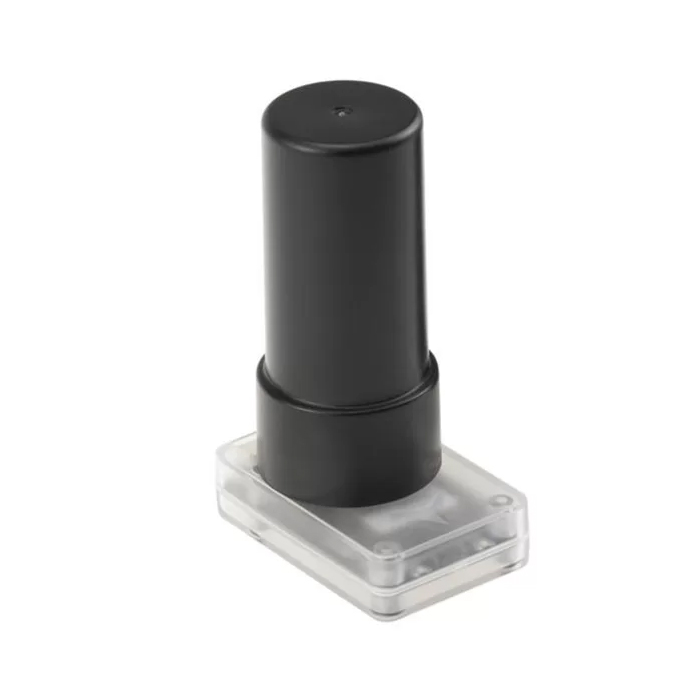

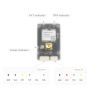
MicoAir MA-RTK-AIR-626 is an affordable RTK GNSS module for drones with ArduPilot firmware, designed mainly for swarms and light shows where centimeter-level accuracy is needed across tens or hundreds of aircraft at once. It works as a rover, meaning it receives RTK corrections from a ground base station or from the NTRIP network, and achieves an accuracy of 1.5cm + 1ppm. Without corrections, it operates as a standard GNSS module with accuracy around 1.5m.
The core is the dual-band UM626N receiver from Unicore, which processes L1 and L5 bands from GPS L1C/A and L5, BeiDou B1I and B2a, GLONASS G1, Galileo E1 and E5a, and QZSS L1 and L5. It can track up to 36 satellites simultaneously, which is the most in the entire MicoAir RTK series. The combination of L1 and L5 makes it possible to remove ionospheric error while also benefiting from the more modern L5 signal, which is more resistant to reflections from buildings and obstacles.
The module includes an IST8310 magnetometer on the I2C bus. GNSS data are sent via UART (3.3V LVTTL) at a fixed baud rate of 115200, which cannot be changed. The output protocol is UBX, compatible with u-blox, so in configuration the module behaves like a standard u-blox GPS. It provides navigation data at 10Hz.
The data outputs are on two connectors. The six-pin GH1.25-6P (GND, VCC, RX1, TX1, SCL, SDA) carries the main UART to the autopilot together with the I2C compass, while the four-pin GH1.25-4P (GND, VCC, TX2, RX2) adds a second UART, which can be used to feed RTK corrections into the module, for example from a telemetry modem. Status is indicated by three LEDs – Power, PVT (position solution) and RTK (correction status), so the fix is visible directly on the board. The antenna connects via an SMA connector and is included in the package. The module measures 44x29x14,7mm and weighs 13g without the antenna.
Important note: The module is supported only by ArduPilot firmware; PX4 is not supported yet.
Key Features
- GNSS chip: UM626N
- Bands: L1 + L5
- Systems: GPS L1C/A, L5; BDS B1I, B2a; GLONASS G1; Galileo E1, E5a; QZSS L1, L5
- Compass: IST8310
- Protocol: UBX (u-blox compatible)
- Baudrate: 115200 (fixed, cannot be changed)
- Refresh rate: 10Hz
- Maximum number of satellites: 36
- Horizontal accuracy: 1.5cm + 1ppm (RTK), 1.5m (standalone mode)
- GPS interface: UART (3.3V LVTTL)
- Compass interface: I2C
- Antenna: SMA connector
- Supported firmware: ArduPilot (PX4 not supported yet)
- Input voltage: 4-5V
- Power consumption: 0.2W
- Connectors: GH1.25-6P, GH1.25-4P
- Size: 44x29x14,7mm
- Weight: 13g (without antenna)
Package Includes
- 1x RTK module
- 1x Antenna
- 1x GH1.25-6P cable
- 1x GH1.25-4P cable