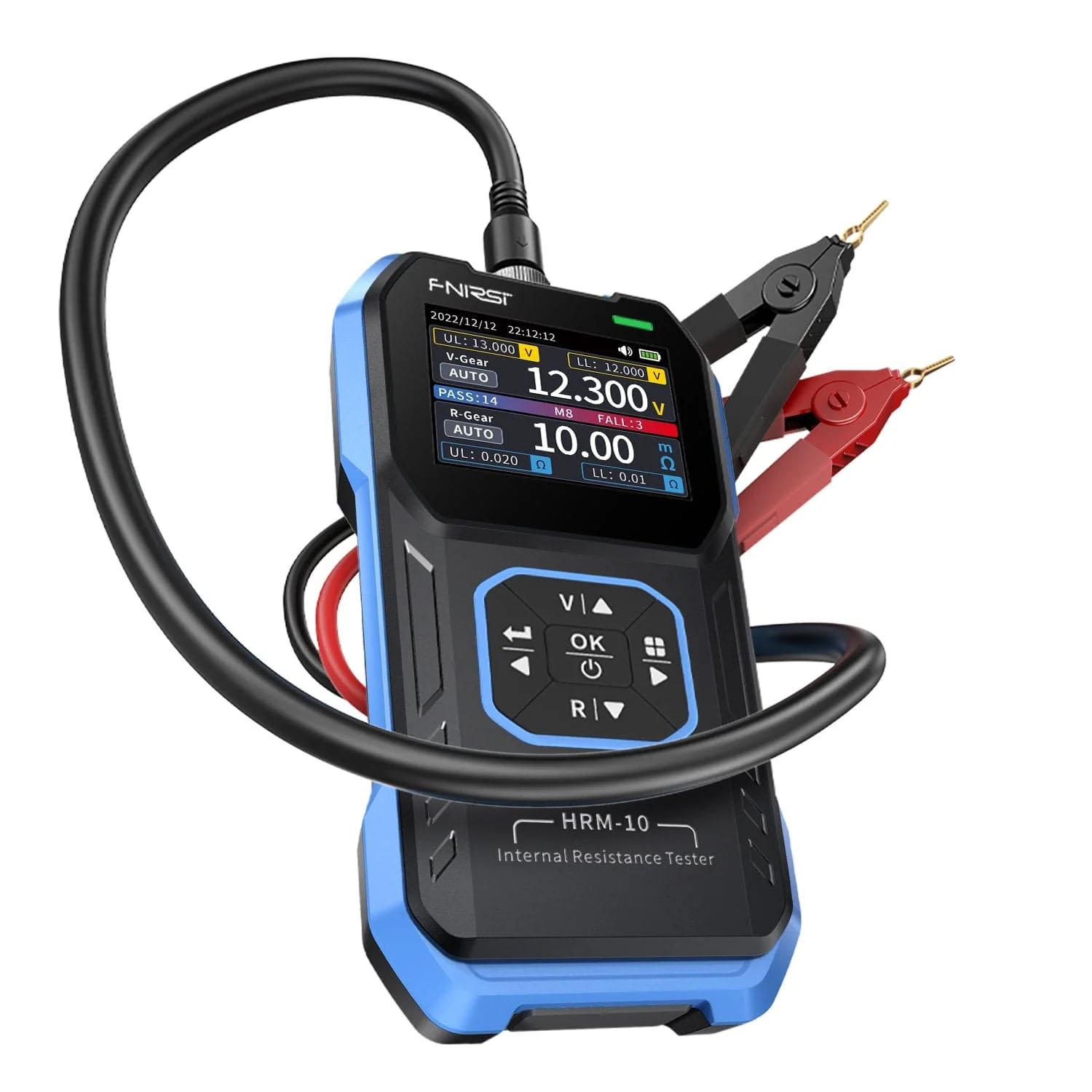


FNIRSI HRM-10 is a handheld battery internal resistance and voltage meter, suitable for checking cell condition and sorting cells. It measures internal resistance and voltage simultaneously and displays both values side by side on a color TFT display. Internal resistance is one of the most reliable indicators of cell condition - it increases with cycle count and aging, so comparing the measured value with a new cell shows how much of the cell's service life has already been used.
Measurement is performed using the four-wire Kelvin method, which separates the current and voltage leads. The resistance of the cables and the contact resistance do not affect the result, which is crucial for values in the milliohm range. Resistance is measured with an AC 1kHz signal, so the device also works with charged cells and does not require them to be discharged. Accuracy is ±0.5% for both quantities.
The resistance range extends from milliohms up to 200Ω and is divided into five steps (20mΩ, 200mΩ, 2Ω, 20Ω, 200Ω) plus automatic mode. Voltage is measured up to ±100V DC in 1V, 10V and 100V ranges. It therefore covers both individual Li-ion and LiPo cells and entire packs. The range can be left on automatic mode or selected manually with the buttons.
A practical function is the sorting mode („sorting mode") - the device compares the measured values with user-set thresholds and immediately evaluates whether the cell passed or not. There are 8 groups of custom threshold values available, so you can switch between several cell types without having to reset settings repeatedly. Results, including the evaluation, are saved in measurement history.
The measured data can be exported to a computer: after connecting via USB-C, the device appears as a flash drive with a table of stored records. It also offers value hold on the display, audible buzzer indication, automatic power-off, and user calibration - each voltage and resistance range is calibrated separately and the calibrations do not affect each other. Firmware is updated the same way via USB. Power is supplied by a built-in 1000mAh lithium battery charged via USB-C (5V/1A).
Important notice: Do not apply DC voltage higher than 100V to the input under any circumstances, and never apply AC voltage. During measurement, the Kelvin probe jaws must be open - their metal parts must not touch each other and must make good contact with the cell electrodes, otherwise the measurement will not be stable. For long-term storage, we recommend keeping the built-in battery charged to about 50% (3.7-3.9V).
Key Features
- Type: Battery internal resistance and voltage meter
- Measurement method: Four-wire Kelvin
- Voltage measurement range: 0-±100V DC
- Voltage ranges: Automatic, 1V, 10V, 100V
- Resistance measurement range: 0-200Ω
- Resistance ranges: Automatic, 20mΩ, 200mΩ, 2Ω, 20Ω, 200Ω
- Accuracy: ±0.5%
- Test signal: AC 1kHz
- Display: Color TFT
- Sorting mode: Yes (8 groups of threshold values)
- Measurement history: Yes
- Data export: Yes (USB-C, flash drive mode)
- User calibration: Yes
- Battery: 1000mAh lithium
- Charging: USB-C (5V/1A)
- Operating environment: -10 to +45°C, humidity <80%
- Storage environment: -20 to +80°C, humidity <80%
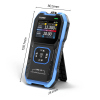
- Size: 158,7x80,5x28,4 mm
- Weight: 225g
User Guides
Package Includes
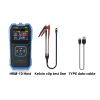
- 1x HRM-10 meter
- 1x Kelvin measuring clamps
- 1x USB-C cable