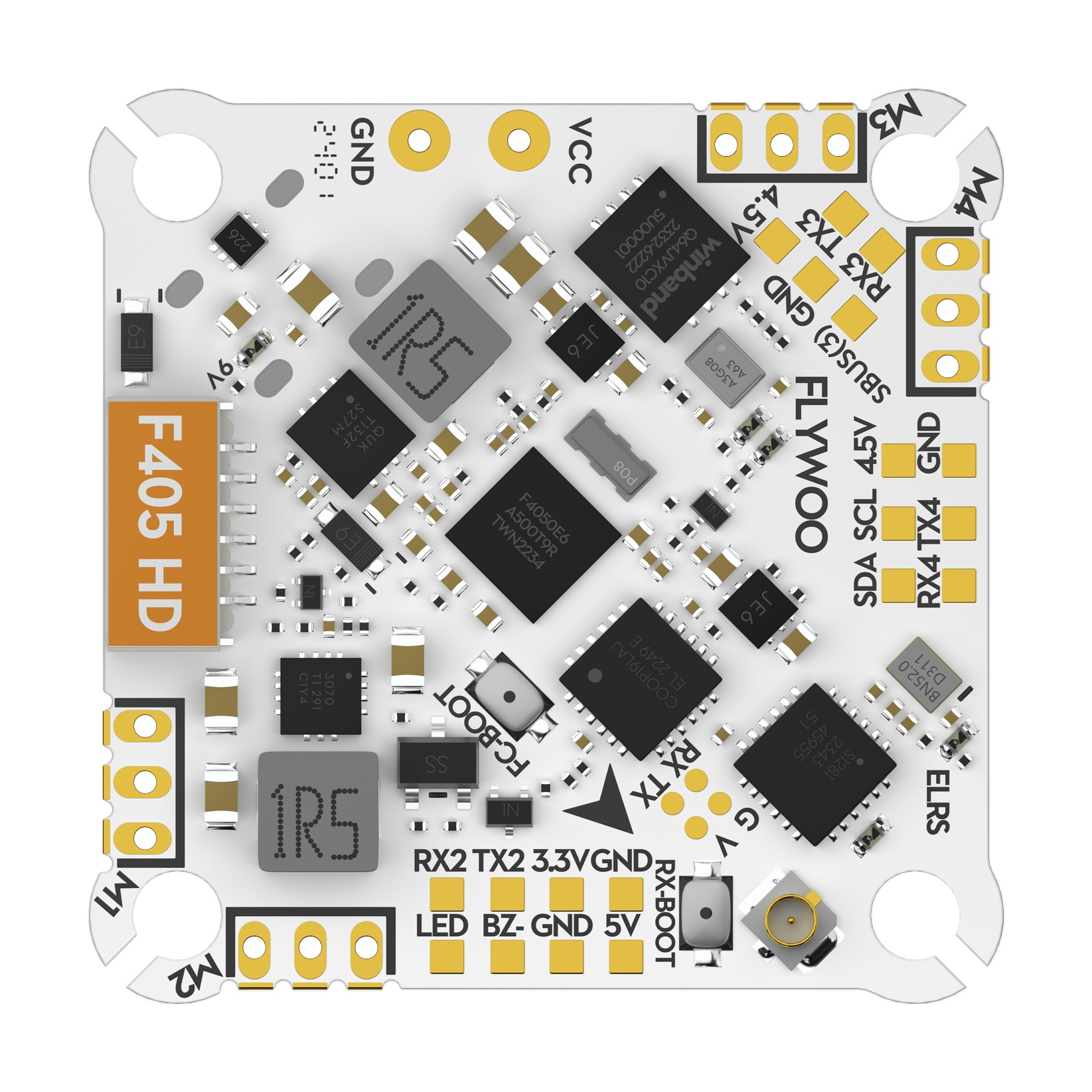
Flywoo GOKU F405 HD 1-2S 12A AIO V2 (FC+ESC+ELRS RX)
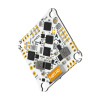
Flywoo GOKU F405 HD 1-2S 12A AIO V2 is an AIO board combining a flight controller, 12A ESCs and an ELRS receiver. The board is suitable for Tinywhoops and toothpicks with digital video transmission powered by 1-2S LiPo batteries. It is designed for use with digital video transmission and therefore does not include a chip for analog OSD.
The flight controller is built around an STM32F405 processor in a BGA package combined with a BMI270 gyro. The board features a DPS310 barometer for altitude measurement and 8MB of blackbox memory. There are 6 UARTs available — the first is internally connected to the ELRS receiver, while the others remain free for a GPS module, digital video transmitter or external receiver. It also includes an SBUS input with inverter and I2C bus pads for connecting a compass.
Power for peripherals is provided by two BECs — 5V/2A for the flight electronics and accessories and 9V/2A for the digital video transmitter. The 9V rail is sized so DJI units do not cut out as battery voltage drops. This rail is additionally switchable by a transmitter switch via the USER2 function. The video transmitter can therefore be left off while setting up on the bench or waiting for a GPS fix, when it may overheat. The function must be enabled in the board firmware.
The ESCs run Bluejay firmware and support a continuous current of 12A per channel. Bluejay supports bidirectional DShot and RPM filtering in Betaflight. Motors connect via the included JST connectors, which makes replacement easy without soldering. The board includes a current sensor.
The integrated ELRS receiver on the 2.4GHz band is built on ESP8285 and SX1280 chips and is connected via UART1 using the CRSF protocol. Unlike SPI receivers, this is a full-featured receiver with its own firmware, updated separately via Betaflight passthrough or Wi-Fi under the Flywoo EL24P 2400 RX target. The external antenna connects via an IPEX1 connector.
The mounting hole spacing is 25,5x25,5mm for M2 screws, board dimensions are 30x30mm and weight is 4,9g. Power is supplied through the included cable with an XT30 connector; the package also includes a cable with a PH2.0 connector for smaller 1S batteries and a capacitor. The USB-C connector is placed directly on the board. The digital video transmitter connects via a six-pin JST-GH connector without soldering.
Key Features
- Input voltage: 1-2S LiPo
- MCU: STM32F405BGA
- Gyro: BMI270
- Barometer: DPS310
- Blackbox: 8MB
- Analog OSD: No (digital MSP DisplayPort only)
- Number of UARTs: 6 (UART1 internally for ELRS)
- I2C: Yes
- BEC: 5V/2A, 9V/2A (switchable)
- RC receiver: Integrated ELRS 2.4GHz (CRSF, UART1)
- Antenna connector: IPEX1 (u.FL)
- ELRS chips: ESP8285 + SX1280
- ELRS target: Flywoo EL24P 2400 RX
- Firmware target: Betaflight FLYWOOF405S_AIO, iNav FLYWOOF405HD
- ESC firmware: Bluejay
- Input protocols: DShot150, DShot300, DShot600, Oneshot125, Oneshot42, Multishot
- Continuous current: 12A
- Current sensor: Yes
- Motor connector: JST
- Power connector: XT30, PH2.0
- USB connector: USB-C on board
- LED: 2x WS2812
- Mounting holes: 25,5x25,5mm M2
- Board dimensions: 30x30mm
- Weight: 4,9g
User Guides
Package Includes
- 1x AIO board
- 1x Flywoo Minimortal ELRS antenna
- 1x XT30 connector with cable
- 1x PH2.0 connector with cable
- 1x connection cable for DJI O3
- 1x capacitor
- 4x JST motor connectors
- 4x M2x10 screw
- 4x M2 nut
- 4x M2 silicone grommet