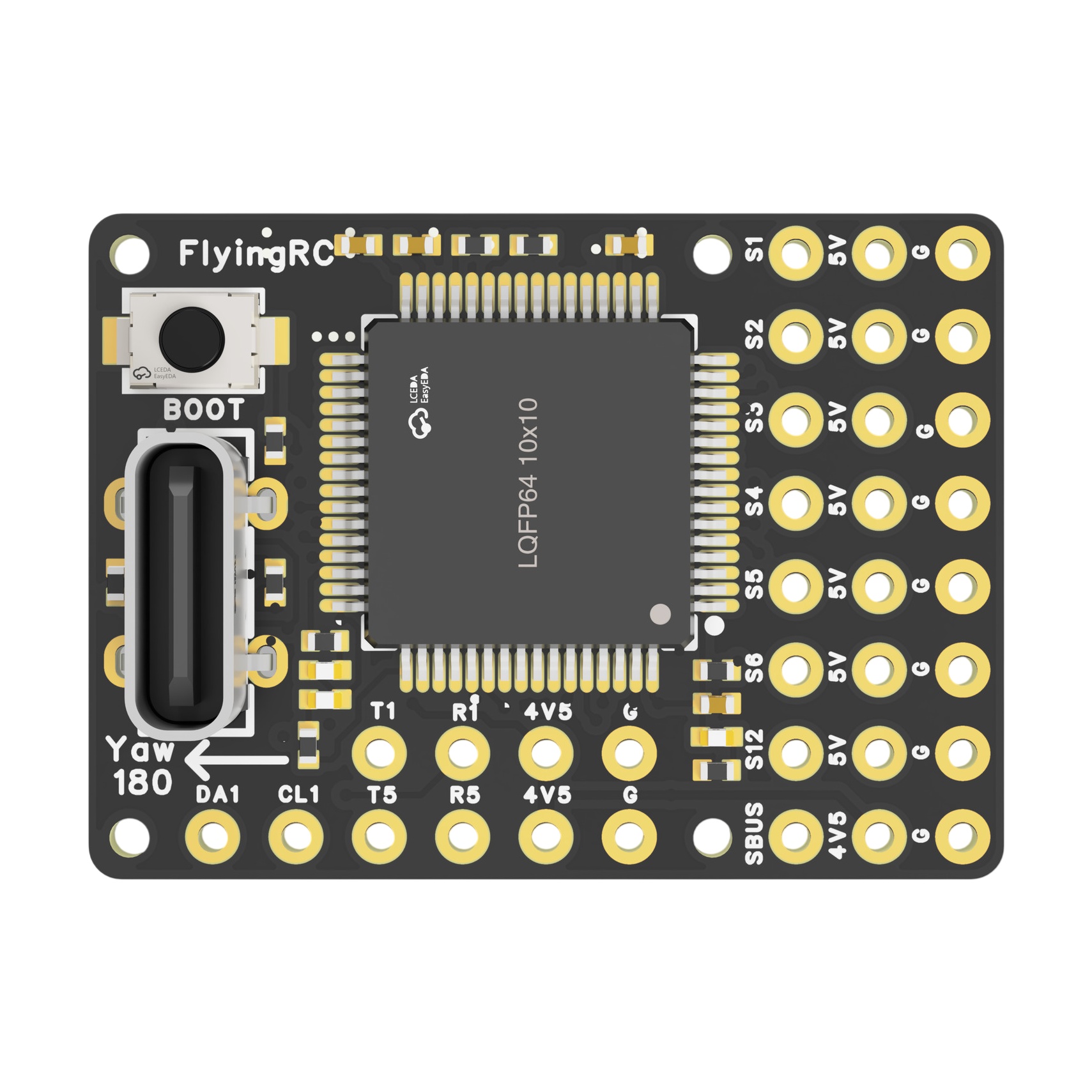


FlyingRC F4Wing Mini MK1 F405 is a miniature flight controller designed for airplanes and flying wings, where every gram and millimeter matters. The board supports ArduPilot, iNav, and Betaflight firmware; it comes with ArduPlane pre-installed, which the manufacturer recommends for airplanes. It measures battery voltage in the 1-6S LiPo (2.5-30V) range, but the controller itself is powered by an external 5V supply.
The flight controller is based on an STM32F405RGT6 processor running at 168MHz with 1MB flash memory, combined with a BMI270 gyro (units released from 25 May 2026; earlier batches used ICM42688P or ICM42605) and an SPL06/SPA06 barometer for altitude measurement. The sensors have two separate LDO regulators, improving power supply stability. Due to its minimal dimensions, the board has no compass, blackbox slot, or analog current sensor.
For peripheral connections, it provides 3 UARTs, a dedicated SBUS input with an integrated inverter, 6 PWM outputs for servos and motor, and a pad for a WS2812 addressable LED strip. All outputs support DShot. An ELRS receiver connects to UART1, GPS to UART5, and the I2C bus can be used for an external compass and an airspeed sensor (MS4525, DLVLR-L10D), which improves airspeed calculation on fixed-wing aircraft. For an external INA226 I2C current sensor, the manufacturer offers modified ArduPlane and iNav firmware. Servos connect to the included pin headers, which are soldered only as required by the build. Configuration is performed via USB-C; with a USB-C to USB-C cable, parameters can also be adjusted from a mobile ground station.
The board is designed for digital video transmission. The SH1.0 6P connector enables direct connection of DJI (including O4), Walksnail, or OpenIPC video transmitters with HD OSD (DisplayPort). The video transmitter is powered directly from the battery through the SH1.0 2P connector, which also serves for battery voltage measurement – the video transmitter must therefore support battery voltage input.
Important notice: The flight controller has no analog OSD or built-in BEC. The controller, receiver, GPS, and servos are powered by an external 5V BEC or an ESC BEC; the manufacturer recommends a supply with an output above 3A (a 3A BEC handles 2-3 9g servos, a 5A BEC handles 4-5 servos). The SH1.0 2P connector is not a power input for the flight controller.
Mounting hole spacing is 17.8x17.8mm M1.2, board dimensions are 27.9x20.3x11.2mm, and weight is only 2.8g without pin headers (5.3g with soldered headers, 6.4g including the mounting base). Install the controller with the USB-C connector facing the nose of the aircraft. Firmware for this board is not included in the official repositories; it is downloaded from the manufacturer's website.
Key Features
- Input voltage: 5V (1-6S LiPo battery voltage measurement, 2.5-30V)
- MCU: STM32F405RGT6, 168MHz, 1MB Flash, 192kB RAM
- Gyro: BMI270 (from 25 May 2026)
- Barometer: SPL06 / SPA06
- Compass: No (external via I2C)
- OSD: No (analog), HD OSD via DisplayPort
- Blackbox: No
- Firmware: ArduPilot (FlyingRCF4WingMini), iNav (FLYINGRCF4WINGMINI), Betaflight (FLYINGRCF4WINGMINI)
- Number of PWM outputs: 6 (+1 for WS2812 LED strip)
- Number of UARTs: 3 + SBUS
- I2C: 1
- CAN: No
- ADC: No (except voltage measurement)
- Digital video transmitter connector: SH1.0 6P (DJI, Walksnail, OpenIPC)
- BEC: No (external 5V power required)
- Current sensor: No (external I2C INA226 support in modified firmware)
- Airspeed sensor support: Yes (I2C, MS4525 and DLVLR-L10D)
- USB: USB-C
- Mounting holes: 17.8x17.8mm M1.2
- Size: 27.9x20.3x11.2 mm
- Weight: 2.8g (without pin headers), 5.3g (with headers)
User Guides
Package Includes
- 1x Flight controller
- 1x 3D-printed mounting base
- 1x Voltage measurement and video transmitter power cable (SH1.0 2P)
- 4x M1.2x5 screw
- 1x 4P pin header
- 1x 6P pin header
- 3x 8P pin header (white, red, black)