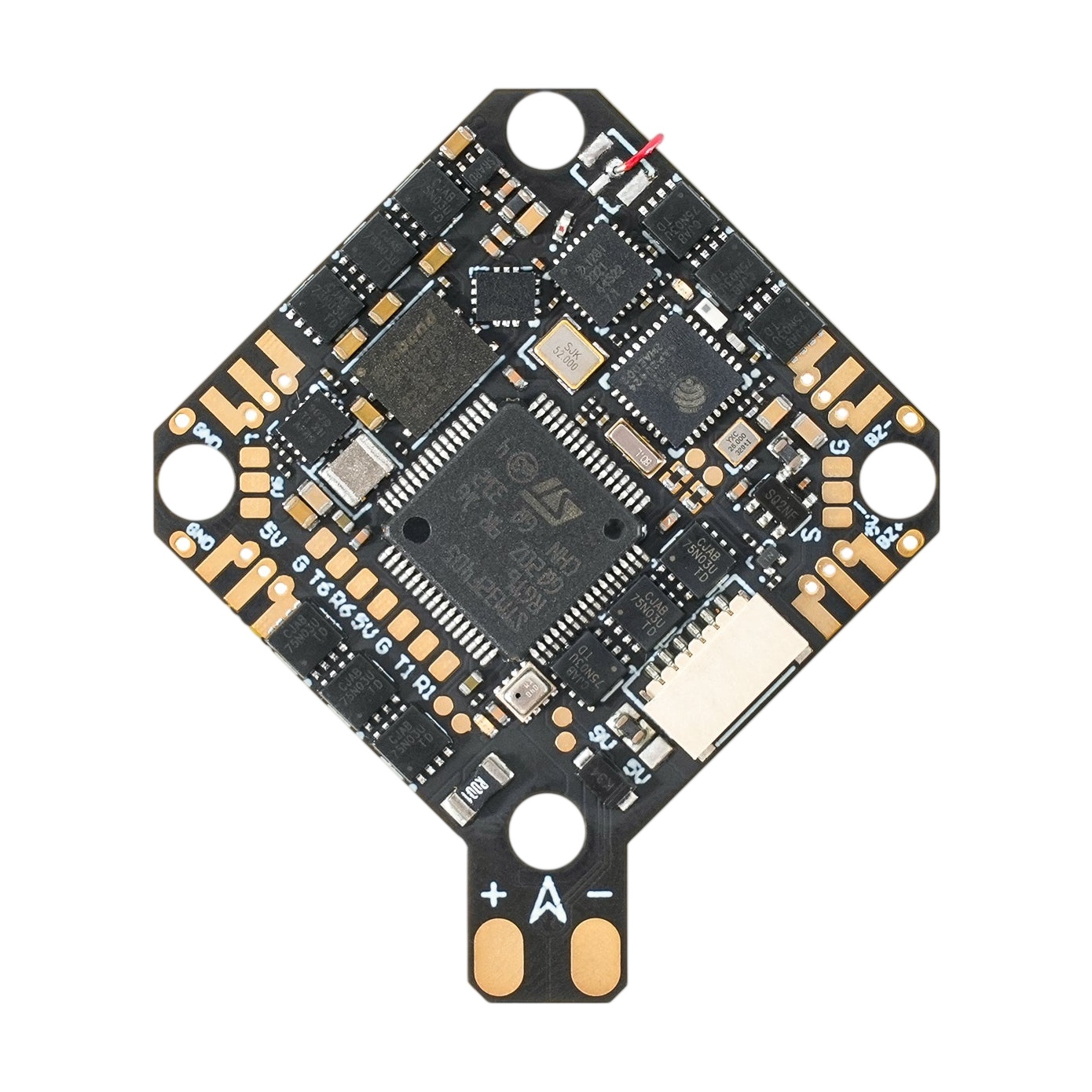
BetaFPV F4 2-3S 20A AIO (FC+ESC+ELRS RX)
BetaFPV F4 2-3S 20A AIO V1 is an AIO board combining a flight controller, 20A ESCs and an ELRS receiver. The board is suitable for 2" to 3" whoops and toothpicks powered by 2-3S LiPo batteries — the manufacturer installs it, for example, in the Pavo Pico, Pavo20 Pro and HX115 SE models. It is designed for use with digital video transmission and therefore does not include a chip for analog OSD.
The flight controller is based on the STM32F405RGT6 processor at 168 MHz combined with the ICM42605 gyroscope. The board features a DPS310 barometer for altitude measurement and 16 MB of memory for blackbox. Peripherals are powered by two separate BECs — 9V/2A for the digital video transmitter and 5V/3A for other accessories.
The digital video transmitter connects via a six-pin PMU connector without soldering; the package includes two connecting cables measuring 30 and 60 mm. The BEC routed to the connector is factory set to 9V. For Walksnail Avatar HD Mini 1S and Lite, which require 5V, the jumper must be resoldered to the 5V pad. For external peripherals such as a GPS module or a receiver using the CRSF protocol, free serial ports and the inverted SBUS input on UART5 remain available.
The ESCs are based on BB51 hardware with Bluejay firmware, which supports bidirectional DShot and RPM filtering in Betaflight. They can handle a continuous current of up to 20A. They support DShot300 and DShot600 protocols and are factory set to a 48 kHz PWM frequency. Motors can be soldered directly to the board or connected via JST1.2 connectors. The board includes a current sensor.
The integrated ELRS receiver at 2.4 GHz is connected via UART and communicates using the CRSF protocol. Unlike SPI receivers, this is a full-featured receiver with its own firmware, which is updated separately via Betaflight passthrough or Wi-Fi. The antenna is made of enamelled wire powered directly from the board; there is no connector for an external antenna. The receiver power can be disconnected by removing the ferrite bead, freeing the UART for other use.
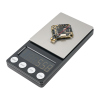
The mounting hole spacing is 26x26 mm for M2 screws, and the board weighs 5.58 g without motor connectors and the power cable. Power is supplied using the included cable with an XT30 connector. To save space, an external USB port connected via a SH1.0 connector is used, brought out to the rear edge of the board; a USB-C adapter is also included. Compared with the previous generation, the solder pads are larger, which makes soldering easier.
Key Features
- Input voltage: 2-3S LiPo
- MCU: STM32F405RGT6 (168 MHz)
- Gyro: ICM42605
- Barometer: DPS310
- Blackbox: 16 MB
- OSD: Digital MSP DisplayPort (without analog OSD)
- Number of UARTs: 4 + SBUS (UART5)
- BEC: 5V/3A, 9V/2A
- RC receiver: Integrated serial ELRS 2.4 GHz (CRSF)
- Antenna connector: No (fixed wire antenna)
- Video transmitter connector: 6-pin PMU, switchable 9V/5V
- Firmware target: BETAFPVF405
- ESC firmware: Bluejay C_X_70_48
- Input protocol: DShot300, DShot600, bidirectional DShot
- Continuous current: 20 A
- Current sensor: Yes
- Motor connector: Solder pads or JST1.25
- Power connector: XT30
- USB connector: External, SH1.0 4-pin
- Mounting holes: 26x26 mm M2
- Weight: 5.58 g (without motor connectors and power cable)
User Guides
Package Includes
- 1x AIO board
- 4x M2x10 metal screw
- 4x M2x10 nylon screw
- 4x M2 nut
- 4x vibration dampener
- 1x SH1.0 4-pin adapter cable
- 1x USB-C to SH1.0 adapter
- 1x XT30 connector with cable
- 1x capacitor
- 1x VTX connecting cable 30 mm (double-sided)
- 1x VTX connecting cable 60 mm (single-sided)