Drone regulations
Updated: November 2026 · based on the rules in force in the Czech Republic as of November 2026
In this chapter we go through the rules for flying FPV drones in the Czech Republic. It is a short, plain-language summary for racing and freestyle pilots. The EU basics (categories, registration, pilot training) are the same in every EU country; registration portals, maps and local zones differ from country to country, so if you fly elsewhere, check your national aviation authority. We try to keep this page up to date, but the information published by the Czech Civil Aviation Authority (ÚCL) and the official DroneMap is always binding.
Quick guide for FPV pilots
- Register as a UAS operator (in the Czech Republic at dron.caa.gov.cz) and mark all your drones legibly with your operator number.
- Complete the online training and pilot test for subcategories A1/A3. You only don't need it if you fly exclusively drones under 250 g that do not fly faster than 19 m/s.
- Find out where your drone belongs: an FPV drone under 250 g and under 19 m/s flies in subcategory A1, all other FPV drones without a C class label in A3.
- Before every flight, open DroneMap and check the zones at your flying spot.
- Fly with an observer who stands next to you and can see the drone.
Key terms
The remote pilot is the person flying the drone. The operator is the natural or legal person who owns or rents the drone. In most cases you are both pilot and operator.
An uninvolved person is anyone who is not taking part in the drone operation and does not know the pilot's instructions: pedestrians, spectators, people in the park. People in cars or behind windows also count as uninvolved.
An assembly of people is a crowd so dense that individuals cannot move away from the drone. You must never fly over an assembly of people in the open category.
A densely populated area (HOP) is an area of continuous buildings. In the Czech Republic, ÚCL defines it digitally as zone LKR316 (clusters of at least 5 buildings), and you can see its boundaries in DroneMap.
There are three categories of operation: open, specific and certified. Recreational FPV flying belongs to the open category, which is divided into subcategories A1, A2 and A3. The specific category requires an operational authorisation or a declaration under a standard scenario, and we will not cover it here.
Registration and training
Operator registration is mandatory for every drone weighing 250 g or more and for every drone with a camera that is not a toy. An FPV drone always has a camera, so registration applies to all FPV pilots. You register in the country where you live; in the Czech Republic on the ÚCL portal dron.caa.gov.cz, logging in with an electronic identity (e.g. bank identity or the Citizen Portal). The registration is valid throughout the EU. Put your operator number on all your drones, including home-built ones, so that it can be read without any aids (sticker, label, QR code). On very small drones it may be placed in the battery compartment.
You complete the online training and pilot test on the same portal. The test has 40 questions and you have two attempts; after a second failure you need to register as a pilot again. When you pass, you receive a certificate for subcategories A1 and A3 valid for 5 years. Subcategory A2 additionally requires practical self-training and another test (30 questions); it usually does not concern FPV pilots.
You do not need the training if you only fly a privately built drone under 250 g that does not fly faster than 19 m/s (about 68 km/h), or a class C0 drone. Typically these are tiny whoops and slower small drones. Toothpicks and 3″ drones tend to be faster or heavier and then belong to A3.
The minimum age of the remote pilot is 16 years. The age limit does not apply to privately built drones under 250 g and to C0 drones that are toys. Younger pilots may fly under the direct supervision of a person who meets all the requirements for a pilot. Exceptions are also possible when flying within model aircraft clubs.
What kind of drone do I have?
Your drone determines the subcategory you may fly in. Drones sold as ready-made consumer drones (e.g. DJI) carry a C0 to C4 class label, and the manual tells you how to fly them. If you modify a drone with a C label in a way the manual does not allow, the label is no longer valid.
FPV quads without a C label, whether you build them yourself or buy them ready-made, count as privately built drones. They are classified by maximum take-off mass (including battery and camera) and speed.
| Drone | Subcategory | Training | Minimum age |
|---|---|---|---|
| Privately built, under 250 g and under 19 m/s | A1 (also A3) | knowledge of the rules | no limit |
| Privately built, under 250 g, faster than 19 m/s | A3 | online test A1/A3 | 16 years |
| Privately built, up to 25 kg | A3 | online test A1/A3 | 16 years |
| Class C0 | A1 (also A3) | read the manufacturer's manual | 16 years, no limit for toys |
| Class C1 | A1 (also A3) | online test A1/A3 | 16 years |
| Class C2 | A2 (also A3) | test A1/A3, practical training and test A2 | 16 years |
| Class C3 and C4 | A3 | online test A1/A3 | 16 years |
In practice, for FPV this means: a drone under 250 g (including the battery) and under 19 m/s flies under A1 rules, anything heavier or faster under A3. The size in inches does not matter.
Rules for every flight
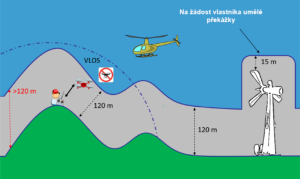
- Fly no higher than 120 m above the ground.
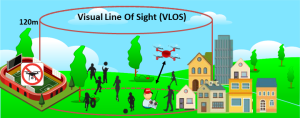
- Never fly over an assembly of people.
- When flying FPV, an observer standing next to you must see the drone (see below).
- Plan the flight using the 1:1 rule: if you lose control, the drone may come down at a distance equal to its height, and no people may be endangered in that area.
- Do not drop anything from the drone and do not carry dangerous goods.
- Do not fly under the influence of alcohol or other substances, or when you are unwell.
- Check the zones in DroneMap before the flight and follow their conditions.
Subcategory A1
A1 is for FPV drones under 250 g and under 19 m/s (and for drones labelled C0 and C1). You must never fly over an assembly of people. A privately built drone under 250 g may fly over individual uninvolved people, but ÚCL recommends avoiding it. In densely populated areas the stricter conditions of zone LKR316 apply (see below).
Subcategory A3
Most FPV drones fly in A3. You may only fly far away from people:
- at least 150 m from residential, commercial, industrial and recreational areas,
- only where you reasonably expect that no uninvolved person will be endangered.
If an uninvolved person enters the flight area, adjust the flight, and if you cannot ensure safety, stop flying. Our recommendation: keep at least 30 m from people passing by, and never less than your flight height. In practice: take a 5″ drone to a meadow or field outside town.

Zones and DroneMap in the Czech Republic
Geographical zones for drones apply in the Czech Republic, and the official map is DroneMap (web and mobile app), which replaced the former DronView. Click a place on the map to see which zones apply there, the maximum height, and whether consent, coordination or marking of the flight is required. The full list of zones is in the ÚCL overview. The zones you will meet most often as an FPV pilot:
- Densely populated areas (LKR316). Only subcategories A1 and A2 may fly here. With an FPV drone without a C label this means only a drone under 250 g and under 19 m/s; FPV drones over 250 g (A3) may not fly in densely populated areas. The 1:1 rule applies: the boundary of your flight area must be at least as far from the drone as you are high. Plan the flight so that you do not fly over uninvolved people (including people in cars and behind windows), and if it happens, keep it as short as possible. Mark the flight area in DroneMap beforehand: area, height and time of the flight, drone type and mass category, and your operator number.
- Controlled airports (LKR314). In control zones (CTR), DroneMap shows for each grid square the maximum height you may fly without coordination; higher only after coordination with air traffic control. In some parts of the zones and in military control zones, coordination is always required and the flight must be marked in DroneMap.
- Uncontrolled airfields, ultralight sites and heliports (LKR315). A grid of maximum heights also applies at uncontrolled airfields. Around ultralight (SLZ) sites, coordination with the site operator is always required within 1.5 km. Around heliports and public interest sites, conditions depend on the distance (up to 200 m, up to 1,000 m and up to 3,000 m).
- Railways, power lines, water sources and roads (LKR311, LKR312, LKR313, LKR317). Flying over selected railway lines, power lines and substations, water sources and roads is restricted; the manager's consent and marking of the flight in DroneMap are often required. Conditions depend on the drone's mass; see the zone card for details.
- Specially protected areas (LKR318). National parks, protected landscape areas and small protected areas: a flight requires a statement or consent of the nature protection authority and marking in DroneMap.
- Sites important for national defence (LKR319). Flights only with the consent of the person responsible for protecting the site and with marking in DroneMap.
- Other airspace (LKR320). Prohibited, restricted and danger areas and military training areas, plus areas published temporarily (NOTAM). Conditions are set by the Aeronautical Information Publication or the NOTAM.
Conditions may change, so check DroneMap every day you fly.
FPV and the observer
Flying with FPV goggles is allowed in the open category if you have an observer next to you. The observer watches the drone directly and keeps an eye on the surroundings. They must stand next to you so you can talk immediately, and they warn you when they see an obstacle or an aircraft. Only fly as far as the observer can see the drone. You as the pilot remain responsible for the safety of the flight.
Insurance
In the Czech Republic, mandatory liability insurance depends on the subcategory and the drone's mass: it is not required in A1, in A3 only for drones over 4 kg, and always in A2 and in the specific category. A typical FPV pilot is therefore not affected. Members of model aircraft clubs follow their club's rules. Some zones may require insurance beyond this. We still recommend checking whether your personal liability insurance also covers drones. Details and minimum limits are on the ÚCL insurance page. Other EU countries have their own rules; for example, Germany requires insurance for every drone.
Remote identification
Direct remote identification (Remote ID) broadcasts the operator number and the drone's position during the flight. It is mandatory for class C1, C2 and C3 drones and for flights in the specific category. It is not mandatory for privately built drones in the open category. If your drone has a remote ID module, enter your full operator number into it, including the three additional characters you received at registration.
Summary
- Operator registration, a legible number on all drones.
- Online test A1/A3 (not required for drones under 250 g and under 19 m/s).
- Under 250 g and under 19 m/s under A1, all other FPV drones under A3 – a meadow far from buildings, not a densely populated area.
- DroneMap before every flight.
- An observer next to you.
Useful links: DroneMap · registration and test – ÚCL · ÚCL FAQ · EASA – drones